
Script & Editing
How the scripts were written and the videos were built, for a short and for a long-form episode.
Short: “The Wrong You Can't Forget”
You asked for more money once. It didn't go well.
That was years ago. Different role, different company, different version of the job market entirely.
But the next time a negotiation comes up, the old outcome shows up first. Not as a memory — as a reference point. A quiet baseline for what's realistic, what's risky, what you should expect.
So the new offer gets measured against the old one, before you've looked at a single actual number in front of you.
Using a mistake means checking it once and moving on. Letting a mistake set your criteria means it's still grading every offer that comes after.
Voice generated with ElevenLabs.
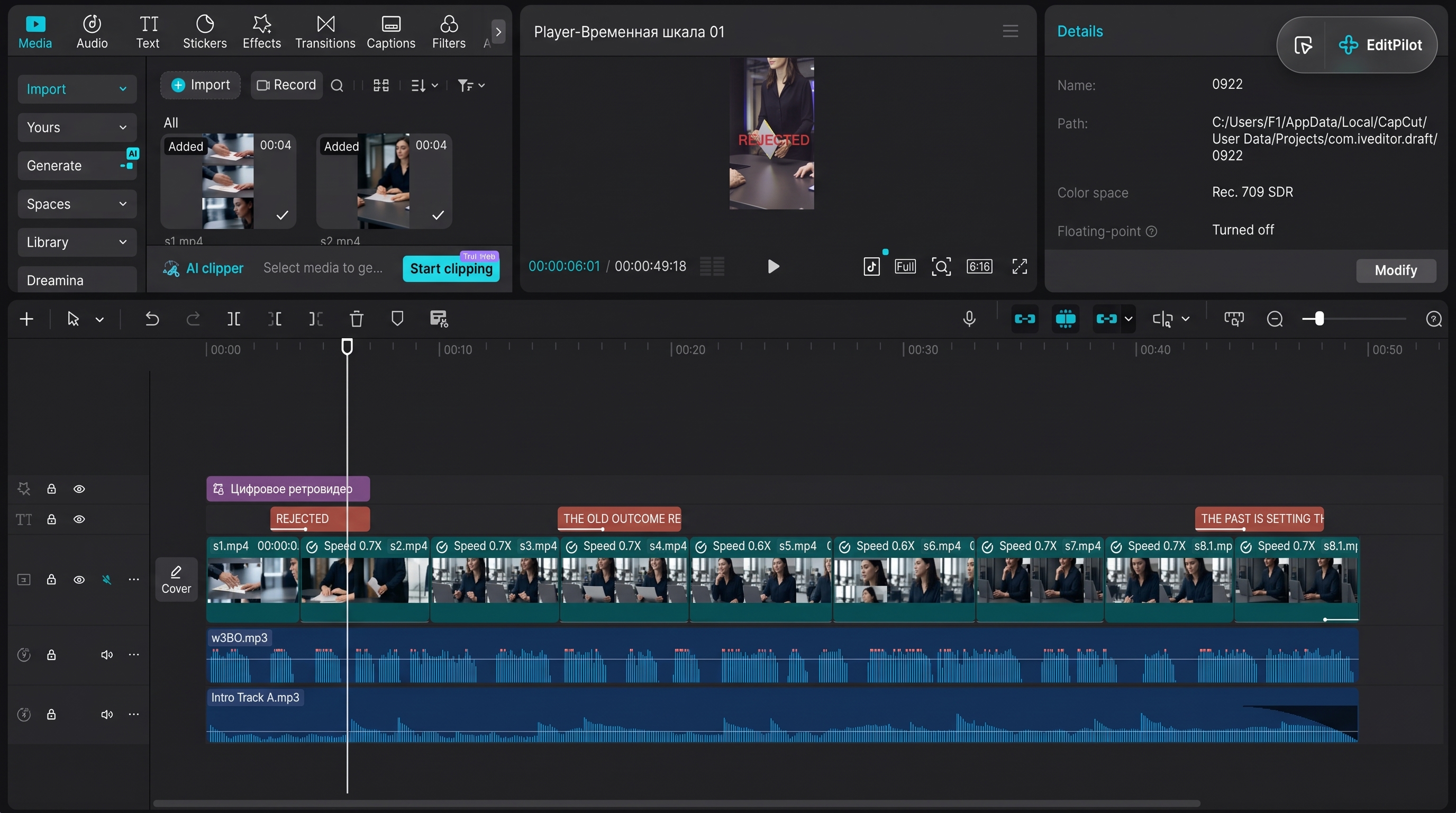
The full CapCut project: AI-generated clips, an ElevenLabs voiceover track, and a music track on one 9:16 timeline.
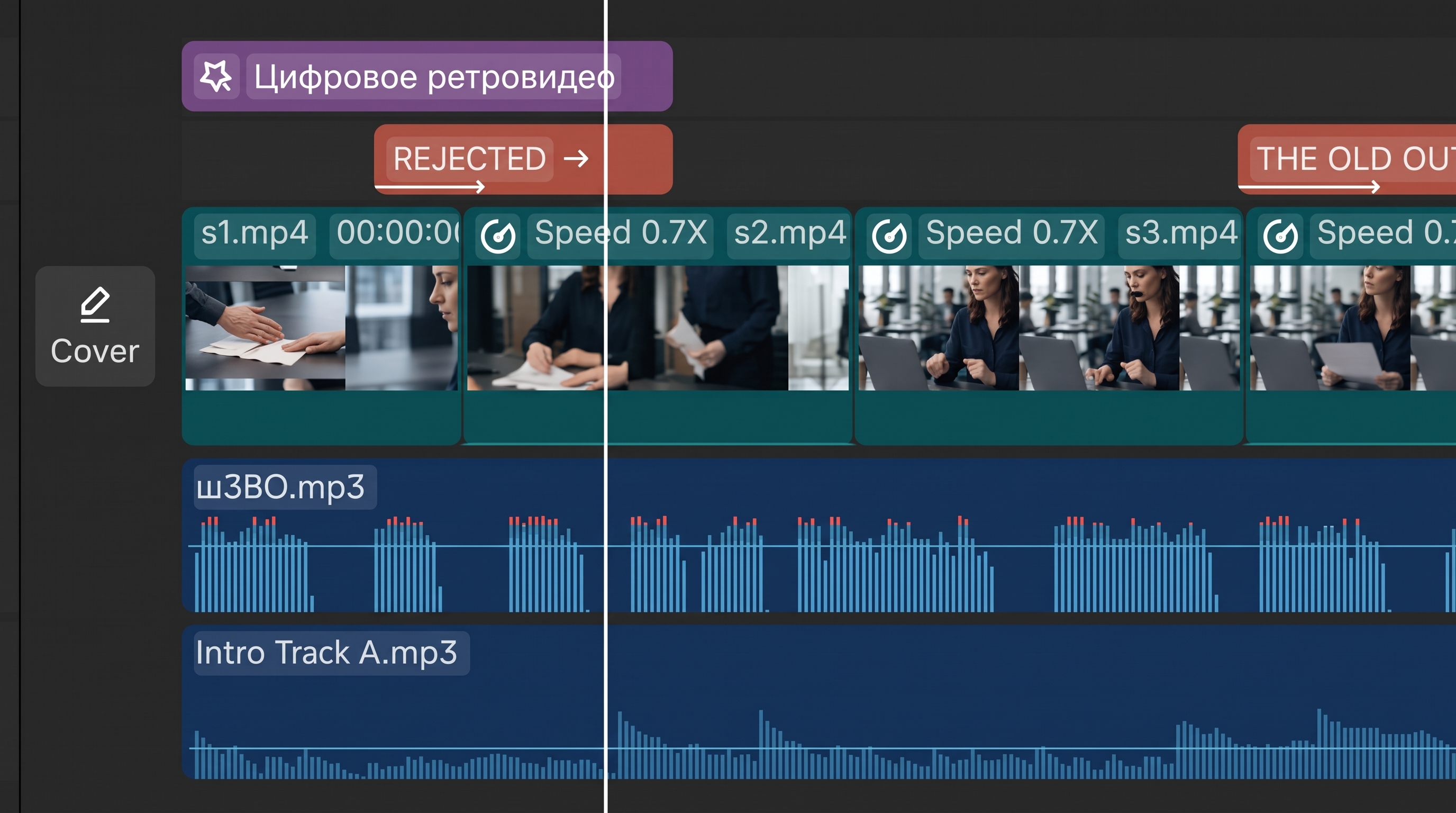
Opening scenes close-up: clips slowed to about 0.7x, a retro video effect, and a “REJECTED” text overlay on scene 1, with the voice and music tracks below.
Long-form: “Why You Don't Trust Your Own Money Decisions”
11:31
final runtime
50
scenes, planned one by one
5
acts, from doubt to a practical method
3
on-camera scenes with an AI presenter
The AI presenter, created with apob.ai, appears on camera only three times, in the opening, the middle, and the closing, with lip-sync. Every other scene is cinematic B-roll under the same voiceover, so the visuals carry the story.
Scenes 1–10
Act 1: The Doubt
Scenes 11–20
Act 2: The Hidden Mechanism
Scenes 21–30
Act 3: How You Learned Not to Trust Yourself
Scenes 31–40
Act 4: The Cost
Scenes 41–50
Act 5: The Shift
Scene breakdown example · Scene 02
Voiceover: “You've checked the price. Compared the options. Read the reviews. You already know your budget — and which option makes the most sense.”
Visual: A laptop with several product comparison pages, prices, reviews, and budget notes. Hands switching between tabs.
Purpose: Establish that the viewer has already done substantial research.
Read the full script (50 scenes)
ACT 1 — THE DOUBT
You already know what you want to do.
You've checked the price. Compared the options. Read the reviews. You already know your budget — and which option makes the most sense.
Then you open Google one more time.
Not because you need more information.
Because you don't trust yourself.
Maybe it's an $800 purchase. A laptop. A course. A piece of equipment you've wanted for months. You tell yourself you're being responsible.
So you search for one more review. Then another comparison. Then a video explaining what the experts would choose.
And after an hour of research, you feel less certain than before.
So you keep looking.
And the cycle begins: decision, doubt, information, more doubt.
ACT 2 — THE HIDDEN MECHANISM
This looks like careful financial thinking. And sometimes it is. Research can protect you from impulsive decisions.
But there's a point where research stops reducing uncertainty — and starts protecting you from having to choose.
Because money decisions rarely come with certainty.
You don't know whether the purchase was worth it until later. Whether waiting was smarter until the opportunity passes. Whether the investment was right until the future arrives.
There's always something you can't know in advance. And that creates a problem.
If you believe a good decision should produce a good outcome, uncertainty starts to feel dangerous.
So your brain starts treating uncertainty as danger — and avoiding the decision starts to feel like protecting yourself.
The question quietly changes. From: what makes sense for me. To: what if I'm wrong.
Now you're no longer evaluating the decision. You're evaluating yourself.
And once you're evaluating yourself, every extra opinion becomes another way to be wrong. One review says it's worth it. Another says it's overpriced. One investor says wait. Another says start now.
ACT 3 — HOW YOU LEARNED NOT TO TRUST YOURSELF
Information stops creating confidence. It just adds another branch to the tree, another place where you could have chosen wrong.
And when every branch contains a possible mistake, doing nothing starts to feel like the safest option.
You don't usually lose financial self-trust in one dramatic moment.
It builds quietly. One small experience at a time.
A purchase you regretted. A mistake someone reminded you about for years.
Advice you followed that turned out badly.
A time you ignored your instincts and later wished you hadn't.
Or watching someone else make money on a decision you were too afraid to make.
Your brain compresses all of that into one simple line: that decision failed.
But sometimes it writes a bigger one: I'm bad at making money decisions.
ACT 4 — THE COST
And once that becomes the story, the next decision is no longer just about money. It becomes a test of your intelligence. A test of whether you can actually trust your own judgment.
So you look for someone else to make the uncertainty disappear.
You ask your partner. Then a friend. Then a forum. Then a video. Then an expert.
And if their answers disagree, you don't feel more informed. You feel less capable of deciding.
This is how decision distrust hides behind responsible behavior.
You compare five products before buying one. You ask three people what they'd do. You watch another video before taking any action.
You keep changing your strategy because someone online has a better one. You wait for the perfect entry point that never quite arrives.
You keep the money sitting in cash, because choosing feels more dangerous than waiting. You tell yourself you're being cautious.
From the outside, this looks responsible. Internally, you're exhausted. And every time you avoid deciding, you teach yourself you can't handle uncertainty.
So the next decision needs even more reassurance. Then more research. Then more reassurance again. Eventually, avoiding the wrong decision becomes more important than making the right one. You delay. You overthink. You second-guess decisions you already made. And sometimes the biggest financial cost isn't a bad decision. It's the decision you never make.
ACT 5 — THE SHIFT
The answer, though, isn't to blindly trust yourself.
That's not confidence. That's overconfidence.
Real financial self-trust sounds different. It sounds like: I can make a reasonable decision with the information I have. And if I learn something important later, I can adjust.
That's a very different kind of confidence. You're not promising yourself a perfect outcome. You're promising yourself a process.
Before an important money decision, ask three questions. First: what do I know. Separate the facts from what you simply found online.
Second: what am I assuming. What are you predicting, or hoping for, or treating as certain when it isn't.
And third: what would make me change my mind. Define that before you decide. Then set a point where the research ends.
Because without a stopping rule, there's always one more article, one more review, one more reason to wait. The goal isn't to eliminate uncertainty. It's to decide how much of it you're willing to live with. Then decide — not when you feel completely certain, but when you have enough information to act.
Afterward, pay attention. If it goes well, notice what your process got right, instead of calling it luck. If it doesn't, don't turn it into a verdict about yourself — ask what you knew, what you assumed, and what you'd change next time. That's how self-trust actually grows. Not from being right every time. From proving to yourself that you can decide, face the outcome, learn, and decide again.
If you want to understand the psychological pattern behind the way you make money decisions, take our free Wealth Psychology Test. The link is in the description. You don't need to trust yourself to always be right. You need to trust yourself enough to be wrong… and still know how to make the next decision.